The part of the decision you're not in
Most B2B go-to-market is built for a conversation that happens after the decision is mostly made.
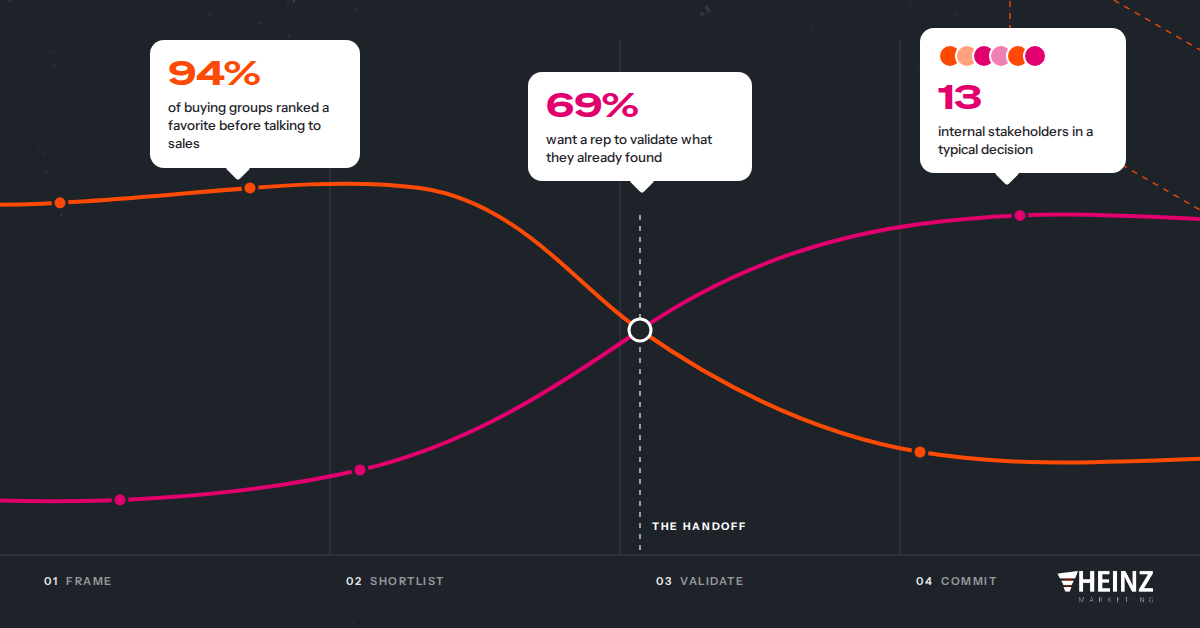
6sense recently surveyed more than 4,000 buyers and found that 94 percent of buying groups had ranked a preferred vendor before their first contact with a seller. They went on to buy that preliminary favorite 77 percent of the time. (6sense sells into this problem, so weigh it accordingly, though they disclose their sample and method, which is more than most.)
By the time your rep is in the room, the buying group has a working answer and is checking it.
The rep who shows up prepared to discover is answering a question nobody is still asking.
Gartner's number for how much of the journey happens without you has been quoted so often it's gone stale, and the honest version is more interesting anyway. 6sense measured first seller contact moving from 69 percent of the way through the journey to 61 percent in a single year. Buyers are engaging earlier than they were, not later. They are just arriving with a shortlist already built.
In the win/loss analysis we run with clients at Heinz Marketing and in a handful of surveys we've run this year with our partners at Consensus, the losses that sting are almost never a feature comparison anybody lost. They are deals where the champion could not carry the room.
Side note: If you're interested in talking to the ebook rather than reading the whole thing, just use our Conversational AI experience below.
Two numbers that look like a contradiction
Gartner surveyed B2B buyers in two related surveys fielded in late 2025 (n=646 and n=645) and published two separate findings from its Sales Practice.
- 67% of buyers say they prefer a rep-free experience. That number was 61 percent the year before, so it is moving.
- 69% of those same buyers say they prefer to validate AI-generated insights with a sales rep.
Too many teams quote one of those and build a whole strategy on it. The useful version holds both.
Buyers want to research without you and decide with you. Gartner's own follow-on measurement is that buyers are 1.8 times more likely to complete a high-quality deal when they use supplier digital tools in partnership with a rep rather than alone. Robert Blaisdell, who leads the research, put it plainly:
"Sales leaders should not interpret buyer preference for digital self-service as a signal that
sellers matter less. It is a signal that sellers need to show up differently, engaging where they can help buyers validate information, reduce risk and move forward with greater confidence."
Differently, later, and with a different job when they get there.
The Buyer Confidence Curve
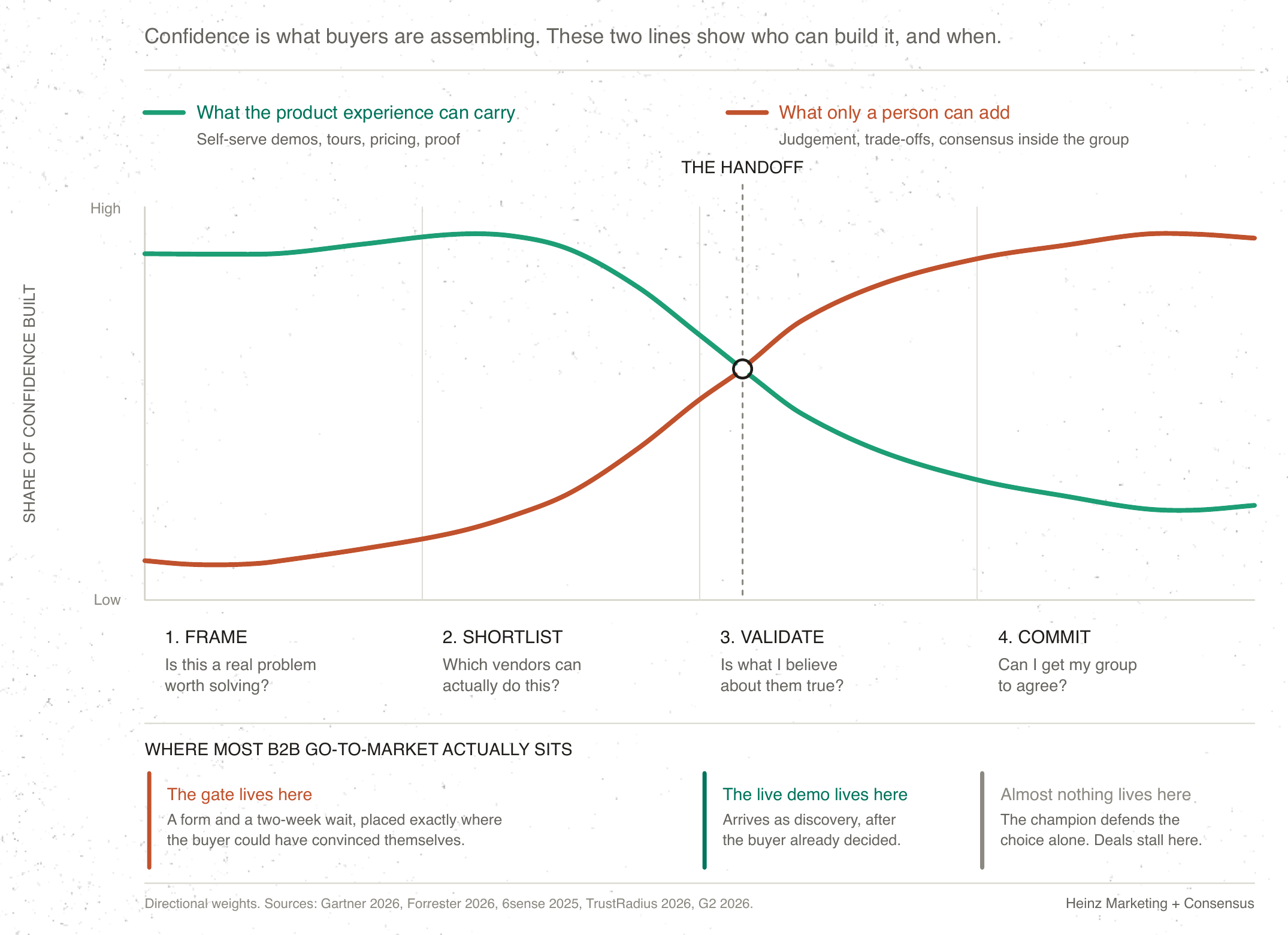
Confidence is what buyers are assembling. These two lines show who can build it, and when.
Buyers have too much information, but even third-party information doesn't inspire confidence. TrustRadius and HG Insights surveyed 1,862 technology buyers this year and found vendor marketing collateral ranked dead last among the resources buyers actually consult, while 47 percent said they trust online resources less than they did a year ago, up from 39 percent.
The curve maps two capacities across four stages of a buying decision. What your product experience can carry, and what only a person can add. They cross once. Most companies put their expensive human hours on the wrong side of that crossing.
Stage 1 - Frame.
Is this a real problem worth solving? The buyer is deciding whether a category exists for them at all. G2 surveyed more than 1,000 software buyers this year and found 51 percent now start research with an AI chatbot more often than with Google, up from 29 percent twelve months earlier, and 69 percent chose a different vendor than they originally planned based on that guidance. Your product experience can do almost all of the work here. A person cannot, because the buyer has not raised their hand.
Stage 2 - Shortlist.
Which vendors can actually do this? This is the stage where self-service earns its keep, and where most B2B companies put a form. TrustRadius has found transparent pricing to be buyers' number one request of vendors for four years running. Forrester reported this year that more than 60 percent of business buyers now use a trial, rising to 78 percent of buyers on purchases of ten million dollars or more. Self-service is the big-deal motion too.
Stage 3 - Validate.
Is what I believe about them true? Here the curve crosses. The buyer has a favorite and an argument, assembled from sources you don't own, and now needs somebody credible to pressure-test it. This is the 69 percent. It is also the highest-leverage half hour your team will spend on the deal, and most teams have already spent it two stages earlier on a walkthrough.
Stage 4 - Commit.
Can I get my group to agree? Gartner found that 74 percent of B2B buying teams show unhealthy conflict during the decision, which they define as conflicting objectives, disagreement on the course of action, or being overruled from outside. Buying groups that reach consensus are 2.5 times more likely to report a high-quality deal. Forrester's 2026 survey puts the typical decision at 13 internal stakeholders plus nine external influencers; its 2024 survey found that 86 percent of B2B purchases stall somewhere in the process.
Four people on the buying committee say yes, one soft no, and the deal quietly dies. Your champion is defending a choice to a group that did not make it, usually alone, usually on a Tuesday, and usually with a deck you gave them for a different audience.
Where most go-to-market actually sits
The gate sits at Stage 2. A form and a two-week wait, placed exactly where the buyer could have convinced themselves. Every panelist on a buyer enablement roundtable I hosted recently said some version of the same thing about gated demos. If a buyer can get a straight answer about your product from a machine in nine seconds, making them wait two weeks and sit through discovery before they are allowed to see it reads as a disqualifying move. They will just go ask the machine again.
The live demo sits at Stage 2 as well, arriving as discovery when the buyer has already decided. It lands as validation whether you designed it that way or not.
Almost nothing sits at Stage 4. This is where deals stall and where nobody is staffed.
What our own polling says about the buyer-seller gap
A poll I ran with my own network asked what buyers actually want from vendors during a software evaluation. It is not a scientific sample, but the shape is hard to unsee.
40 percent said answer my questions, fast. 31 percent said let me explore on my own. 19 percent wanted a guided demo. 10 percent just wanted pricing.
Most sales motions are built for the 19 percent.
A second poll asked how marketing teams define their own focus in support of sales. 58 percent said brand, pipeline, conversion and sales enablement. Another 32 percent said brand plus pipeline generation.
So, a clear majority of marketers already believe enablement is theirs. Buyer enablement is the part that still does not have a program owner, a roadmap, or a number attached to it in most companies.
Four Plays
Play 01: Move the gate to where it buys you something
Ungate the product experience through Stage 2 and gate at the point where the buyer wants something only you can give them. An on-demand walkthrough, an interactive tour, a real price range and a proof point that matches their industry should all be reachable without a form.
TrustRadius found that 40 percent of buyers used free trials, and 74 percent of those who did called it the most influential resource in their evaluation. That is the highest influence-to-usage ratio in the study. Demos ran a close second.
There is a version of this that goes too far, and it is worth naming. Ungating everything and capturing nothing leaves your team blind. The move is to trade the form for instrumentation: know who watched, what they replayed, where they stopped, and who they forwarded it to.
What good looks like: a buyer can answer "can this do the thing I need" in under ten minutes, at 11pm, without talking to anyone, and your team knows they did.
Play 02: Design the demo to travel
The single most useful benefit of an automated demo is that it's built for being forwarded around the buying group.
Your champion is going to have to re-tell your story to people who were not on the call. Right now, most of them do it from memory, with a deck built for a different audience. That is the weakest link in the whole chain, and it is the one nobody instruments.
Build the product experience in segments a champion can forward selectively. The security lead does not need the same nine minutes as the CFO. When those segments are watched by people you have never met, you have discovered the buying group without asking anybody to fill out an org chart.
What good looks like: you can name four people in the account who engaged, and at least two of them arrived because somebody inside forwarded the thing.
Play 03: Re-point the live conversation at validation
If the buyer arrives at Stage 3 with a favorite and an argument, the live meeting should be built to test that argument rather than restart it.
Practically, that means the rep opens with what the buyer already believes, not with discovery questions the demo already answered. It means being willing to say where you are the wrong fit. Gartner found that 51 percent of buyers think they are more likely to encounter misleading information from generative AI, compared with 49 percent who say the same about a sales rep, a near tie. Neither side is trusted by default. Being specific about your limits is the cheapest credibility available.
What good looks like: your reps can articulate, in one sentence, what the buyer believed walking in.
Play 04: Enable the group, not the individual
This is the play almost nobody runs, and it is the one with the most room.
Gartner found that buyers experiencing content relevance at the buying-group level were three times more likely to report a high-quality deal, while individual-level content relevance had a 59 percent negative impact on group consensus.
Hyper-personalizing to each stakeholder actively fragments the room (Consensus can help with this personalization at scale). Everybody gets their own version of the truth and then they cannot agree on which problem they are solving.
So, build for the group. A shared summary of what the group has collectively seen. A one-page answer to the objection procurement always raises. Proof points the CFO can forward without translation. Automated demos offer a scalable level of personalization that allows you to build for the stakeholder.
What good looks like: your champion has something to send the room that was built for the room.
The 10-question diagnostic
Score each yes. Under six and the curve is inverted somewhere.
- Can a stranger see your product working, in a meaningful way, without giving you an email address?
- Can they find a real price or price range on your site?
- Does your product experience break into segments a champion can forward selectively?
- Do you know, by name or by role, who else in an account watched something?
- When a buyer books a live meeting, does the rep know what that buyer has already seen?
- Are your reps trained to open on what the buyer already believes?
- Do you have a named owner for buyer enablement, with a roadmap and a number?
- Do you produce anything built for the buying group rather than for one persona?
- Does your champion have something to defend the decision with when you are not in the room?
- Can you name the stage where your deals most often stall, from data rather than from a feeling?
What to measure
Most teams measure demo requests, which tells you about your form and almost nothing about your buyer.
Four better ones:
Stakeholders discovered per opportunity.
How many people in the account did your product experience surface that your rep did not already have? This is the number that tracks to Stage 4 survival.
Time from first product exposure to first live conversation.
Getting shorter while win rates hold means self-service is doing the qualification, and getting shorter while win rates fall means you removed friction that was doing real work.
Share of live meetings that open on validation.
Ask your reps. It is a coaching metric, not a dashboard metric, and it moves faster than anything in your CRM.
Stall rate by stage.
Forrester's 86 percent is the industry number. The useful version is yours, by stage, so you can see whether you're losing deals at Shortlist because the gate is too high or at Commit because the champion is alone.
A note on the vendor benchmarks you'll see quoted in this category, including ours. Demo platform telemetry showing that buyers who watch nine demos close at higher rates is a correlation, and an obvious one: engaged buyers were already more likely to buy. Useful as a directional signal for where to invest, not as evidence that the ninth demo caused anything. Hold it loosely.
Where this goes
The temptation with all of this is to read it as a story about removing people from the process. It isn't. The buyers who most want a rep-free evaluation are the same buyers who most want a person to check their thinking before they commit.
What changes is the arithmetic. When the product experience carries Stages 1 and 2, your expensive human hours are available for Stage 4, where deals actually die, and where almost nobody is standing right now.
Marketing already owns this. A clear majority of marketing leaders say enablement is in their scope. Buyer enablement is the part still waiting for an owner, a budget line, and a place on next year’s plan.
Pick one stage of the curve, find out where yours is inverted, and fix that one first.
About Matt Heinz
Matt Heinz is Founder and CEO of Heinz Marketing and hosts CMO Coffee Talk and Sales Pipeline Radio. Consensus is a partner of Heinz Marketing. The data and opinions here are Matt's.
About Heinz Marketing
Focused on helping clients drive predictable growth via a revenue-responsible focus, Heinz Marketing helps B2B marketing teams elevate their impact and contribution to business outcomes that matter. Heinz Marketing's proven Predictable Pipeline methodology has been successfully customized and implemented at countless organizations, changing the trajectory of marketing work, careers, and lives.
The Heinz Marketing team is made up of full-funnel experts who speak the language of sales, empowering clients with strategy and tools for success.
Contact Heinz: Acceleration@heinzmarketing.com
Learn more: heinzmarketing.com
About Consensus
Consensus is the world's most trusted demo platform, rated #1 in Demo Automation on G2, connecting agent, buyer, and seller-led demos, from interactive product tours and AI demo agents to video and live demos with real-time data injection, into one continuous experience. Every interaction creates Demo Intelligence, so revenue leaders shorten deal cycles, raise win rates, and forecast with confidence.