

Introduction: Where Engagement Becomes Momentum
What if the playbooks that once built your pipeline are now quietly slowing it down?
Today’s B2B buyers don’t want to be sold, they want to move on their own terms. Buying committees are larger, journeys are more self-directed, and digital-first engagement is the default operating model.
That reality hasn’t changed since our 2025 report. What has changed is the bar.
Last year, we focused on engagement: How buyers interact with demos, how often they watch, and why digital product experiences matter earlier in the journey. Engagement proved its value. It showed up clearly in the data.
This report goes one step further. While engagement is a stepping stone, what you do with that data is what truly matters.
Side note: If you're interested in talking to the report rather than reading the whole thing, just use our Talkable experience below.
That’s why this year we zoomed out—from treating engagement as a signal of interest to understanding momentum as the driving force behind pipeline progression. Top-performing teams aren’t just counting clicks or views. They’re asking:
- Is engagement compounding into commitment?
- Is it accelerating decisions?
- Is it creating measurable forward motion in the funnel?
Because if it isn’t, momentum stalls. And stalled deals are expensive.
Pressure on velocity isn’t theoretical:
- Most of the buying journey happens before sellers are invited to the dance. B2B buyers now spend only about 17% of their total purchase journey in direct contact with potential suppliers, meaning roughly 80% of decision shaping happens independently of sales…often before any live interaction takes place.
- Buyers are choosing self-directed engagement. 61% of B2B buyers prefer a rep-free buying experience, signaling a strong shift toward self-service research and evaluation. Buyers also actively avoid irrelevant outreach, which can further slow momentum when sellers lean on traditional touchpoints alone.
- Complex decisions slow deals down. 77% of B2B buyers describe their most recent purchase as highly complex or difficult, reflecting the growing number of stakeholders and internal review cycles that dampen deal momentum unless engagement is orchestrated strategically.
This report doesn’t ask “are buyers engaging?” it asks “is engagement propelling deals forward?” We break down how demo automation and orchestrated engagement strategies create the conditions for momentum to build—converting passive interest into predictable revenue motion.
|
About the Data The insights in this report are based on two key sources:
|
Executive Summary: Top 5 Takeaways Revenue Leaders Can’t Ignore
Buyer behavior didn’t just evolve this year, it compressed. Attention windows shrank. Buying committees expanded. And the margin for wasted motion effectively hit zero. Across millions of product experience interactions, the data tells a consistent story: momentum is no longer about getting more time from buyers—it’s about earning more impact from the time you get.
- Buyer Attention Is Shorter, But Sharper
The average demo view time dropped to 5 minutes, 14 seconds, down 5.5% year-over-year. Buyers skip filler, replay what matters, and disengage when value isn’t immediate. Winning teams aren’t asking for more attention: They’re delivering clearer value faster.
- Buyers Decide Fast, Your Content Has to Keep Up
Most buyers won’t click through more than four steps in a product tour before bouncing. While demos often run 15+ minutes, buyers self-select just 5 minutes of the most relevant content. - Automated Product Experiences Drive ROI and Scale
Manual demos are costly—$288–$330 per session, with top Enterprise teams saving ~$40M+ through automation. Automation also recovers 240,000+ hours previously spent on repetitive live demos. - High-Intent Signals Predict Revenue Early
Clicks, replays, and engagement patterns are strong early indicators of buyer intent. Prospects who engage with demos on your website, for example, spend 2.3× longer watching than average demo viewers - Multi-Stakeholder Demoboards Are Nearly 2X More Likely to Be Tied to Opportunities
Demoboards shared with 7 or more stakeholders are tied to opportunities 36% of the time, which is nearly double (1.9X) the 19% association rate for demoboards with zero stakeholders.
Driving Engagement
Buyer attention is getting shorter. Full stop. Compared to 2025, prospects are spending less time with demos and product tours, not because they’re less interested, but because they’re far more decisive about what earns their focus. Every click, skip, replay, or drop-off now carries more meaning than ever.
In this section, we examine how modern buyers engage with interactive product experiences across sales-led shares, follow-up embeds, and website-hosted content. The data reveals a clear shift: engagement is concentrated, intentional, and increasingly intolerant of filler.
For sales and presales teams, the mandate is precision. The teams winning aren’t asking buyers for more time. They're delivering clearer value in less of it. By aligning content, timing, and channel to these evolving consumption patterns, revenue teams can turn brief interactions into momentum-driving conversations and move deals forward faster, even as view times continue to compress.
Average Demo View Times Per Segment
The average view time for demos across companies and industries is 5 minutes and 14 seconds, down 5.5% from 2025. SMBs continue to lead view times, which indicates a need for more detailed information or a different engagement style compared to Enterprise clients.
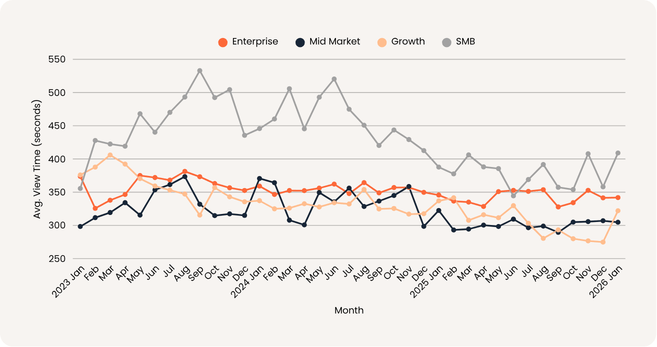
Note: Segment definitions are based on employee headcount and reflect the distribution of our active customer base. While ranges may vary slightly across industries, we define segments as follows: SMB (1–249), Growth (250–999), Mid-Market (1,000–9,999), and Enterprise (10,000+).
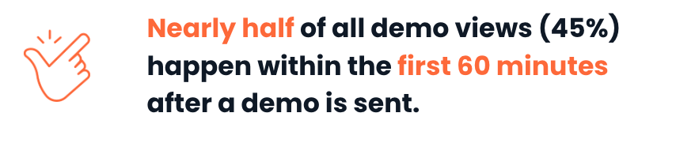
Nearly half of all demo views (45%) happen within the first 60 minutes after a demo is sent. This immediate engagement window is a strong signal of buyer readiness—indicating which prospects are actively prioritizing the evaluation rather than passively bookmarking it for later.
When buyers engage quickly, it’s often because the demo has landed at the right moment, aligned to an active conversation, internal urgency, or an impending decision.
Time-to-view isn’t just a metric; it’s intent in motion. The faster a demo is watched, the clearer the signal that a deal is worth advancing.
Average Demo View Rates Per Segment
View rates help to understand the engagement or interest level in DemoBoards across different segments and time periods. A higher view rate indicates better engagement, while a lower view rate might suggest that the DemoBoards are not resonating well with recipients.
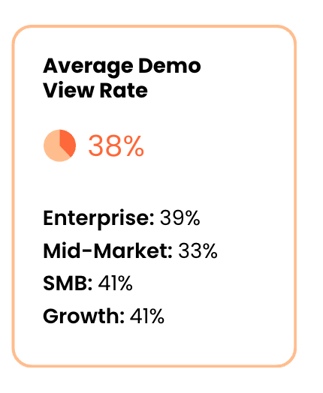
The average view rate among all segments is 38%, with the highest view rates among SMB and Growth companies. This number across segments has not changed. A steady 38% view rate shows buyer engagement has stabilized, even as deal complexity increases. But stability isn’t acceleration. The data points to an engagement plateau, where current content captures attention without consistently moving deals forward.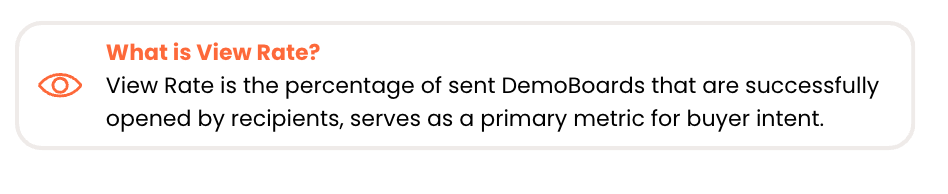
|
SUCCESS STORY Coupa Sees a 31% Demo View Rate Coupa didn’t just improve their sales process—they redefined it. By putting interactive demos in the hands of buyers, they created an experience that was both engaging and informative. The result? Sky-high view rates and clear signals of serious buyer interest. It's the spark that lit their shift to a faster, more buyer-centric sales cycle. “We’re initiating a transformation to redefine how businesses buy software. Consensus is a big part of that, and we’re just getting started.” - Ronan Keroudan, SVP of Global Value Solutions Consulting Key Stats:
Explore how Coupa is using interactive demos to decrease buying cycle times. |
Average Number of Stakeholders Discovered
No meaningful deal moves forward on the strength of one advocate alone. Progress happens when multiple stakeholders, each with their own lens on risk, value, and timing, start moving in the same direction. Identifying that group early isn’t optional anymore. It’s the cost of entry. And in most organizations, the earliest window into that alignment starts with how buyers interact with your product experience.
This year, the average number of unique stakeholders identified per demo remains steady at four. That consistency matters. It shows that while buying groups have grown more complex, stakeholder visibility hasn’t expanded at the same pace.
Discovered Stakeholders Engage 2.2× Better Than Primary Recipients
Here’s the plot twist most revenue teams miss: the people you didn’t send the demo to are often the most engaged.
Discovered stakeholders (those looped in when a demo is shared internally) engage at a 61% rate, compared to just 28% for the primary recipient. That’s more than 2.2X higher engagement from stakeholders who weren’t part of the original send. Even more telling? They show up faster, viewing demos an average of 88 hours sooner than the primary recipient.
Buyers don’t move in straight lines. Deals progress laterally, not linearly. Once a demo enters a company, it finds its way to the people who actually drive momentum—economic buyers, technical validators, and internal champions who do due diligence after hours.
Why it matters:
- Engagement isn’t confined to your main contact—it compounds as the buying group self-organizes.
- Faster views signal urgency and relevance, not passive forwarding.
- These stakeholders aren’t “secondary.” They’re often the real decision accelerators.
If you’re only optimizing for the primary recipient, you’re managing optics—not outcomes. The real signal lives in discovered stakeholders. That’s where intent sharpens, consensus forms, and deals quietly move forward while everyone else is still waiting for a reply.
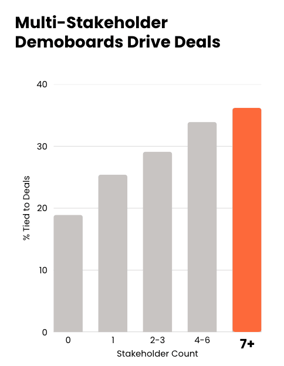
The correlation between multi-threading and deal attachment is unmistakable:
- Adding 1 stakeholder increases the chance of being tied to a deal by 35% vs. the baseline.
- Adding 7+ stakeholders increases the chance of being tied to a deal by 92% vs. the baseline.
Multi-threaded demos win. Sellers must actively encourage demo sharing and track stakeholder discovery as a primary health metric for their opportunities.
|
SUCCESS STORY
The Access Group Discovers 371 Stakeholders in 7 Days The Access Group used product experiences to gain clear visibility into their buyers. By tracking engagement and seeing who shared demos internally, their team quickly identified key stakeholders across the buying committee. With that intel in hand, they concentrated their efforts where it mattered most—accelerating deal cycles and improving sales efficiency. "Consensus tracking and tracing are invaluable. There's not a product out there, yet, that does it in the same way. That ability to harvest stakeholders and to see engagement has definitely helped us focus on the deals that are likely to have some velocity." - Adam Freeman, Head of Presales Key Stats:
See how The Access Group utilized demo sharing to uncover key stakeholders. |
Average Number of Days to Open Demos & Product Tours
You work hard to build those demos and product tours—crafting the right narrative, tailoring the content, and making sure it hits the mark for your buyer. But once you hit “send,” what happens next? One of the most common questions we hear is: How long does it actually take someone to open the content?
If you're sending an on-demand demo or product tour, you're likely hoping stakeholders engage with it quickly, especially if it's meant to move a deal forward. But the data tells a different story.
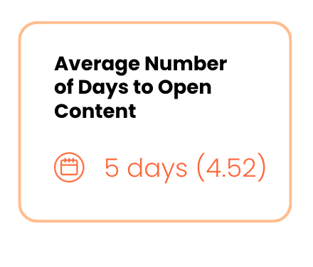
Across all countries, it takes an average of 5 days for buyers to open the content you’ve sent.
|
SUCCESS STORY AdvancedMD Sees a 60% Demo Share Rate AdvancedMD made it easy for buyers to explore—and explain—their product. "I sent the video demo to the billing manager, who sent it to the doctor, who watched it, who sent it to two others in the office. Doctor loved what he saw. We did a brief live demo today which sealed the deal." - AE Key Stats
See how AdvancedMD increased their lead-to-close rate with engaging product experiences. |
In the next chapter, we’ll unpack the factors that impact open rates and view times, and share strategies you can use to accelerate engagement and get eyes on your content sooner.
Optimizing Discovery Questions
Personalization is the goal, but discovery is the tax a buyer pays to get there. Our data shows that while Discovery Demos are growing in popularity, there is a clear "friction threshold" where buyer participation drops off.
The Law of Diminishing Discovery
While the maximum number of questions asked in a single demo reached as high as 22, the reality of buyer behavior is far more conservative. Currently, only 42.75% of discovery demos actually include questions, but for those that do, the engagement window is narrow.
- The Power of One: 75%+ of viewers will only answer a single discovery question before moving to the content.
- The Hard Ceiling: 90% of viewers answer 2 or fewer questions.
- The Conversion Sweet Spot: Even though demos average 1.91 questions, viewers only provide answers to 1.37 questions on average.
Takeaway: Be Ruthless with Your Questions
To maintain momentum, your discovery phase must be high-impact and low-effort. With a 72% answer rate on demos that actually use questions, the engagement is there—but it is fragile.
Ask two questions at most. Use the first to segment the buyer by role and the second to identify their primary pain point. Anything beyond that risks the "drop-off zone," where the effort of the discovery outweighs the perceived value of the demo.
Peak Time & Hour to Send Content
If you want your content to land at just the right moment—when your buyers are most likely to open, watch, and act—the timing of your send matters more than you think. Patterns in the data reveal clear windows of opportunity, both by day and by hour, where engagement spikes and attention is at its peak.
Whether you’re sending demos, tours, follow-ups, or key enablement content, hitting that sweet spot can make all the difference.
Best Engagement Days
Engagement patterns are remarkably consistent across time zones, but the behavior underneath them has shifted in meaningful ways.
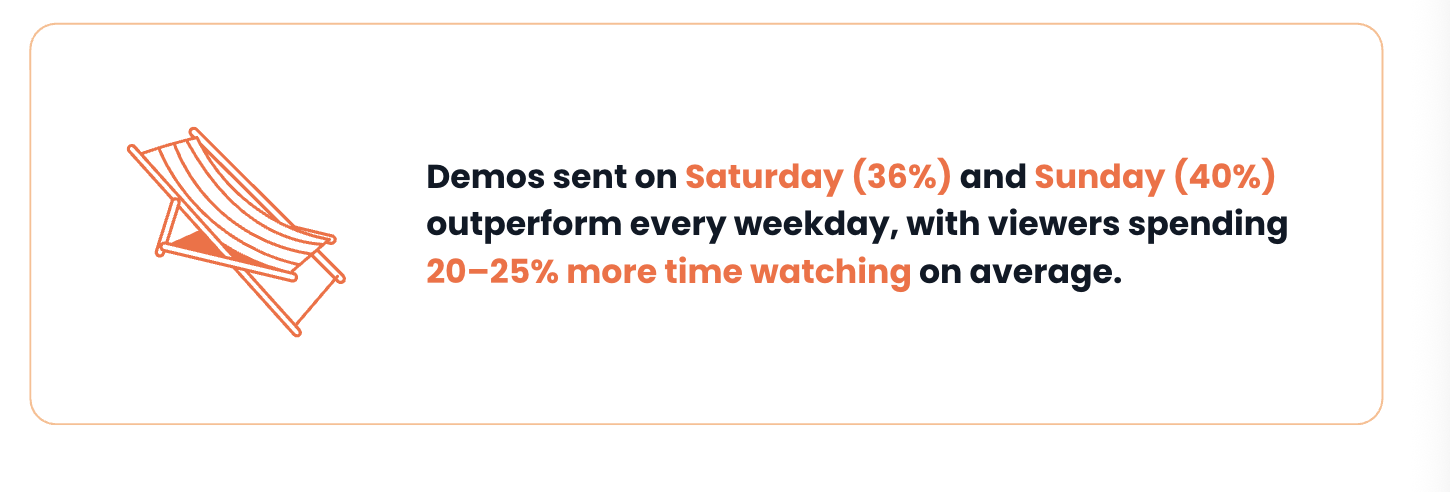
Weekends deliver the highest engagement rates and deepest consumption, even though overall send volume is lower. Demos sent on Saturday (36%) and Sunday (40%) outperform every weekday, with viewers spending 20–25% more time watching on average. This isn’t casual browsing…it’s deliberate, high-intent evaluation.
Weekend engagement is concentrated among buyers who are carving out uninterrupted time to dig in. These are often senior decision-makers doing serious research outside standard business hours.
Weekdays, meanwhile, remain the workhorse for volume and momentum. Engagement rates are tighter across Monday–Thursday, hovering in the low 30s, with Monday and Thursday performing best for scalable sends. Friday drops to the bottom of the weekday stack as attention shifts away from active evaluation.
Best Engagement Times
Timing matters just as much as the day, and the data shows a clear hierarchy.
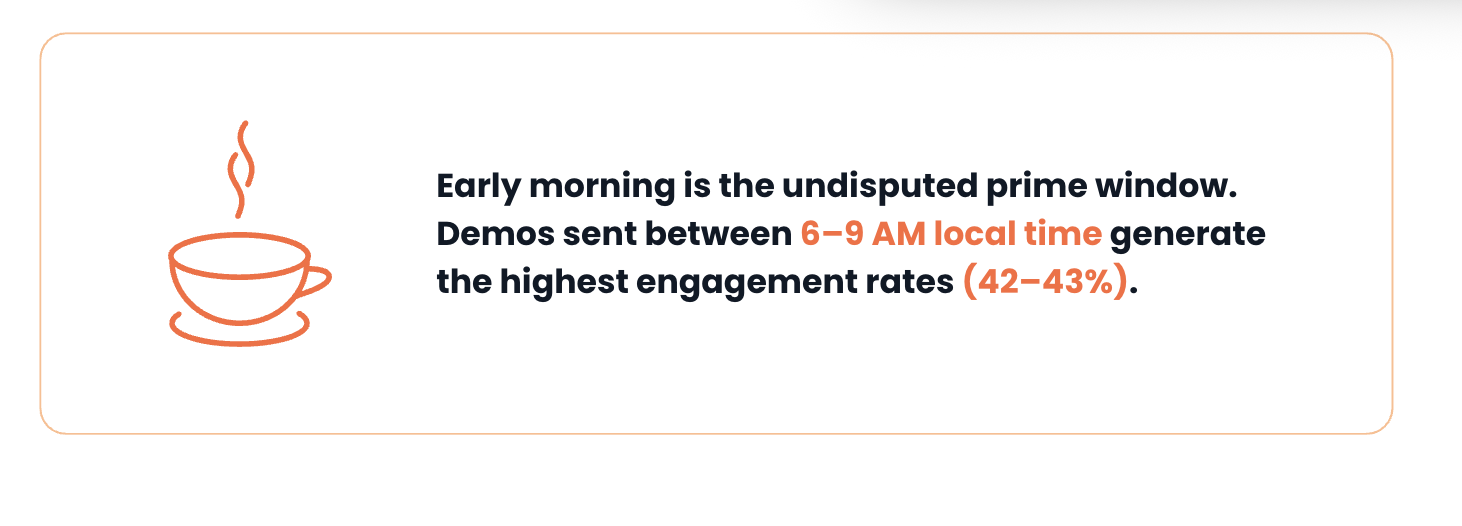
Early morning is the undisputed prime window. Demos sent between 6–9 AM local time generate the highest engagement rates (42–43%), significantly outperforming every other time block. This window captures buyers during their pre-meeting scan, when attention is highest, and inboxes are quiet.
Late morning and lunch hours remain solid performers, but engagement steadily declines through the afternoon. The 3–6 PM block is where demos go to wait. Evenings perform worst overall, as buyers disengage or defer.
When day and hour are combined, the pattern sharpens further:
- Highest-performing combinations: Monday–Friday, 6–9 AM, with Monday and Thursday leading the pack.
- Lowest-performing combinations: Midweek and Friday evenings.
If your goal is engagement—not just delivery—schedule demos for the start of the day, not the end. Afternoon and evening sends require a different strategy and shouldn’t be treated as interchangeable with core workday distribution.
|
SUCCESS STORY
Oracle Saves 12,800 FTE Hours with Scalable Presales Oracle, a global technology giant, recognized the need to scale its presales efforts efficiently without a proportional increase in headcount. With a Product Experience Platform, they empowered their sales teams and customers with on-demand product knowledge. This strategic move led to significant time savings for their presales team, enabling them to handle a larger volume of opportunities and reduce operational costs dramatically. “We scaled presales by over 20% without adding headcount.” - Todd Goulds, Oracle CEGBU Key Stats:
Discover how Oracle achieved significant presales efficiency and cost savings. |
Replay Rate: The Hidden Buying Signal
Replay behavior is rising—and that’s not accidental.
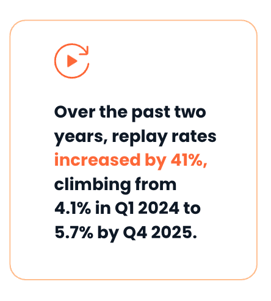
Over the past two years, replay rates increased by 41%, climbing from 4.1% in Q1 2024 to 5.7% by Q4 2025. Buyers don’t replay demos casually. When someone comes back for a second or third look, it’s a strong indicator that the content is either informing a decision or circulating inside the organization.
Replay activity signals a shift from passive interest to active evaluation. This is the moment when buyers are validating claims, revisiting specific workflows, or pressure-testing the product against internal requirements.
In many cases, replays happen as the demoboard is being shared with additional stakeholders, turning a single viewing experience into a collaborative decision asset. As a result, replay behavior often precedes deeper stakeholder engagement and opportunity progression.
Driving Deal Momentum Through Automation
When it comes to closing enterprise deals, one of the most powerful indicators of buyer intent is demo engagement. The data is crystal clear: the more demos a buyer watches, the more likely they are to buy.
The 9+ Inflection Point
Internal data shows a transformative shift in deal outcomes based on the volume of engagement.
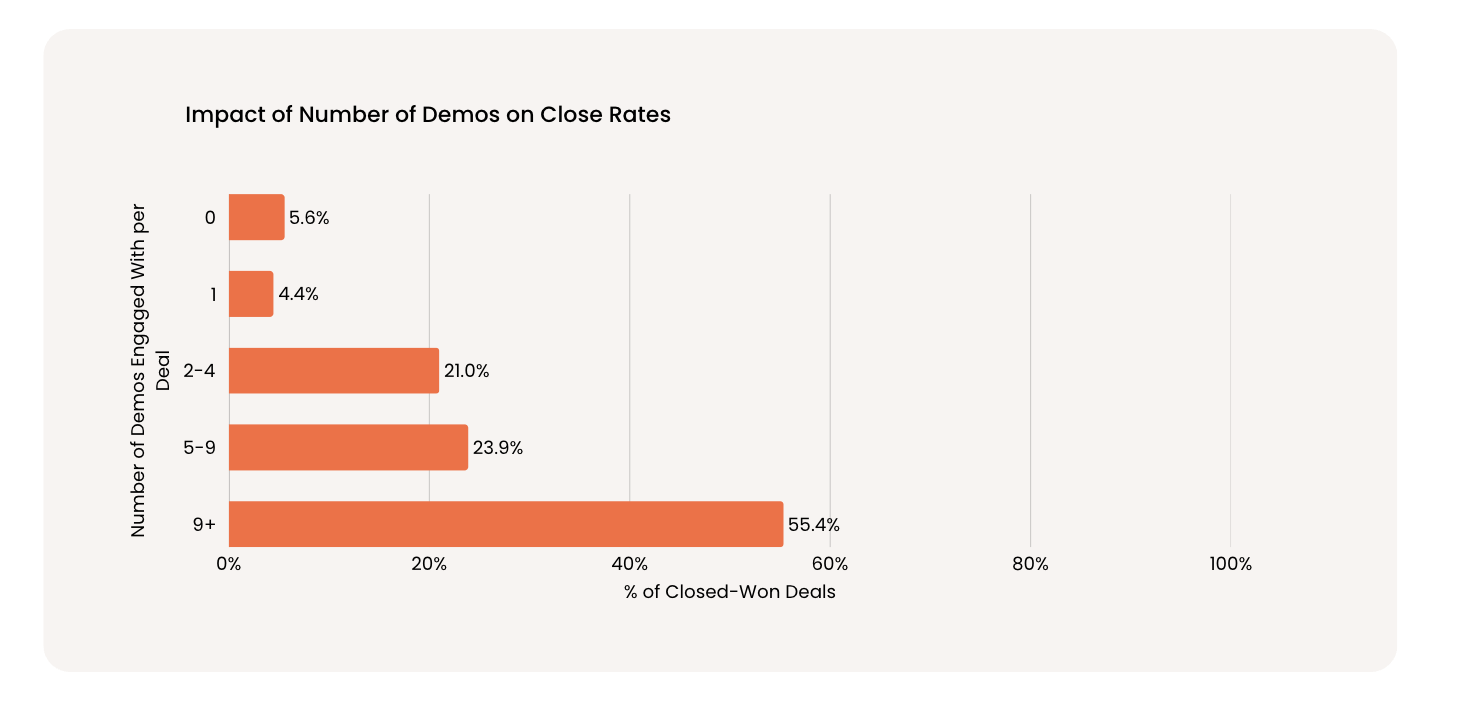
- The Tipping Point: Buyers who engage with nine or more demos show a close rate of over 55%, representing an 8–10x increase compared to prospects who never watch a demo.
- Early Signal: Even light engagement—just two demos watched—is enough to trigger a measurable increase in win rates.
- Quality over Quantity: While total video runtime averages 20.32 minutes, buyers typically self-select and focus on 5.15 minutes of the most relevant content.
.png?width=653&height=255&name=Buyer%20Behavior%20Report%202026%20-%20v2%20(2).png)
|
SUCCESS STORY BlackLine Achieves a 54% Increase in Win Rate By sharing tailored demo experiences and tracking buyer engagement, their Solutions Consultants zeroed in on qualified opportunities. That focus paid off—with a notable lift in win rates driven by more informed, personalized engagement. "Our Solutions Consultants now get to deflect low-impact demos and focus on building and maintaining momentum in the opportunities that are most likely to close. We see the impact of Consensus throughout the sales cycle, making our time with the buyer count. It also helps us continue to influence buyers between live meetings as they revisit content and share demos with their fellow stakeholders." - Tom Edwards, Consensus Global Adoption Leader Key Stats:
Learn how BlackLine maximized their presales impact and boosted their win rate. |
Automated Stakeholder Discovery: The Silent Momentum Driver
One of the most significant barriers to momentum is the "hidden" stakeholder. Automation serves as a force multiplier by identifying these individuals as the demo is shared internally.
- Scaling the Buying Committee: On average, Consensus Enterprise accounts are uncovering over 10,700 "hidden" stakeholders per account through automated discovery.
- Viral Internal Expansion: The "Stakeholder Discover Rate" is a critical health metric. High-performing segments see rates of 58% to 63%, meaning for every 10 people a rep targets, roughly 6 more stakeholders are identified automatically.
- Revenue Attribution: This discovery isn’t a vanity metric; it is directly tied to revenue momentum. For Consensus’ top enterprise accounts, automated discovery has contributed to an average of $29.1M in gained revenue per account.
High-Intent Signals
The strongest buying signals surface long before a sales conversation ever starts.
Every click, view, and interaction leaves intent behind—and the teams that capture it gain the advantage.
When buyer engagement is turned into actionable intelligence, revenue teams can spot deal momentum early, prioritize the right opportunities, and move fast with confidence—not gut feel.
That intent shows up clearly in the data:
- Conversion Stickiness: Marketing conversions offer an early preview of buying behavior. Prospects who convert spend an average of 7:39 watching demos…2.3× longer than the average viewer.
- Active Engagement: High "Demoboard View Rates," such as the 83% seen in top-performing Enterprise accounts, serve as an early warning system for high-intent deal momentum.
Showing ROI of Demo Automation
For years, product demos were treated as a “free” step in the sales process. In reality, they’re one of the most expensive motions in revenue. Every live demo pulls highly specialized talent into a one-to-one interaction that simply doesn’t scale.
When teams actually quantify the time and expertise behind each session, the cost of manual delivery becomes impossible to ignore. Demo automation isn’t just a modernization play, it’s how teams shift from a reactive cost center to a scalable efficiency engine, driving growth without adding headcount or friction.
The True Cost of Manual Demos
Traditional, manual demos are expensive, often costing organizations over $330 per session when accounting for the salaries and prep time of Sales Consultants and Account Executives. Automation drastically reduces this "per demo" cost, creating a wide margin of savings.
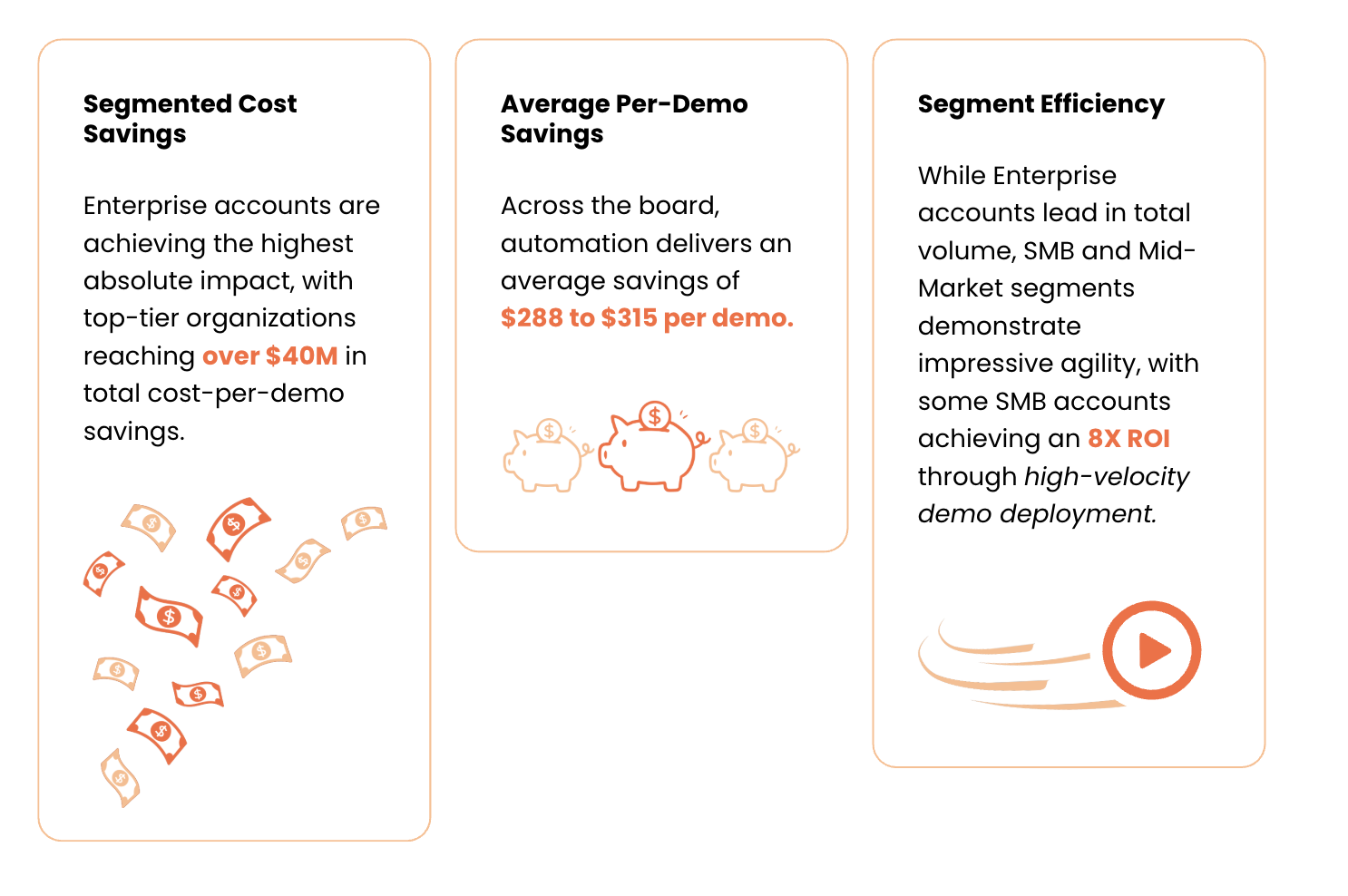
- Segmented Cost Savings: Enterprise accounts are achieving the highest absolute impact, with top-tier organizations reaching over $40M in total cost-per-demo savings.
- Average Per-Demo Savings: Across the board, automation delivers an average savings of $288 to $315 per demo.
- Segment Efficiency: While Enterprise accounts lead in total volume, SMB and Mid-Market segments demonstrate impressive agility, with some SMB accounts achieving an 8.02% ROI through high-velocity demo deployment.
Operational Time Recovery
The ROI isn't just found in the budget; it’s found in the calendar. Automation acts as a time machine for sales teams.
- Enterprise Time Gains: Large-scale organizations are reclaiming an average of 240,200 hours. This is time previously spent on repetitive introductory overviews that is now reinvested into high-value closing activities.
- The Scale of Reach: This efficiency has allowed the ecosystem to scale to a staggering 186.23K total active demos and over 5.2M total views.
Best Practices for Maximizing Engagement With Content
Teams are pouring serious time into long, complex demos—while buyers skim, share selectively, and move on. The result? High effort, low yield. We’re building more than buyers can realistically consume, and momentum pays the price.
This section breaks down where engagement actually converts into revenue—and where it leaks. You’ll see the signals that indicate real buying momentum, the formats that drive stakeholder expansion, and the operational shifts that help teams move faster without burning cycles. Less demo theater. More deal velocity. Net-new efficiency unlocked.
Leverage "Viral" Stakeholder Signals
Momentum is driven by the expansion of the buying committee. In Enterprise accounts, automation has discovered an average of 10,700 stakeholders per account.
Monitor your "Stakeholder Discover Rate." If you see a demo being shared internally (a high share rate), it is a signal of viral momentum. Don't wait for the buyer to tell you who else is involved; use the discovery data to proactively map the committee and tailor content for those new personas.
Embrace Short Form Content & Personalization
In our DemoIQ Assessment, we asked GTM teams to share how they juggle content creation with growing buyer demand. There was a clear pattern: creating demo content is time-consuming, and teams are stretched thin.
The majority of demo creators reported spending 1–2 days to produce simple demo assets like micro-demos, while complex, multi-path demos can take 3–4 weeks to build. And that's just for one asset.
It’s no surprise that 55% of demo creators cited bandwidth and resource limitations as the primary reason they struggle to keep up with demand for new demo and tour content. As buyer expectations evolve and sales cycles require more personalization and faster turnarounds, this production gap becomes a real friction point.
.png?width=651&height=286&name=Buyer%20Behavior%20Report%202026%20-%20v2%20(3).png)
But there’s another layer to the problem—a misalignment between the effort that goes into creating demos and how buyers actually engage with them.
Our data shows that the average length of a demo video is 15 minutes and 14 seconds, yet the average view time is just 5 minutes and 14 seconds. That’s a major drop-off. Teams are investing days—or weeks—into long-form content that buyers are often only partially consuming. In other words, we’re overbuilding and underserving.
.png?width=312&height=240&name=Buyer%20Behavior%20Report%202026%20-%20v2%20(5).png)
Today’s buyers expect content that’s easy to consume and tailored to their needs. That’s why teams need a smarter, more scalable approach to demo and content creation—one that mirrors how buying groups actually engage.
Micro-demos, easy-to-navigate tours, and modular assets free up your team’s bandwidth and improve buyer engagement. For example, many Consensus customers use chaptering to turn longer video demos into personalized, bite-sized experiences, ensuring each stakeholder sees what matters most to them. And with Gartner reporting six to ten stakeholders in a typical buying group, that level of personalization isn’t just helpful—it’s essential.
.png?width=335&height=364&name=Buyer%20Behavior%20Report%202026%20-%20v2%20(4).png)
|
SUCCESS STORY
Atlassian Achieves 487 New Leads per Week Atlassian strategically used interactive demos for their lead generation engine. By offering easily accessible and engaging product demos, they captured a substantial number of new leads every week. The demo interactions equipped their team with valuable insights to help them understand which features resonated most with potential buyers. “The demo is a top-performing asset. It consistently converts quality leads and helps our team understand which features are trending and what buyers generally think when they come in contact with our product.” - Ken Connally, Head of Technical Product Marketing Key Stats:
Explore how Atlassian leverages product experiences for consistent lead generation and insights. |
Operationalize the "9+ Tipping Point"
The data reveals that 9+ demo views is the "magic number" that leads to a close rate of over 55%. To improve momentum, teams should not just track views but strategically curate demo experiences that encourage deep consumption.
If a deal has only 2 or 3 views, it is in a "low momentum" state, use multi-path or "Advanced" demo types to encourage the stakeholder to explore more chapters and hit that 9+ inflection point.
Improving ROI isn't just about sending more demos; it's about reclaiming expensive human capital. Since a single manual demo costs $330.53 in labor, every automated view represents a direct preservation of budget.
Use automated demos to handle the "Harbor Tours" and "Introductory" overviews. This allows your Solutions Consultants to skip the repetitive $330 sessions and reinvest their time into late-stage, high-complexity technical wins.
Schedule Content Around Buyer Attention—Not Seller Convenience
If you want demos and follow-ups to be opened, watched, and acted on, timing isn’t a tactic—it’s a multiplier. Demo engagement follows predictable behavioral patterns, and the best send times depend on whether you’re optimizing for volume or intent.
Weekdays drive consistency. Monday through Thursday deliver steady engagement and are best suited for scalable sends, pipeline coverage, and keeping deals moving. Buyers are in work mode, processing inbound content alongside meetings and internal discussions. Among weekdays, Monday and Thursday mornings consistently perform well as buyers reset priorities and close out decisions.
But the highest-intent engagement doesn’t happen midweek…it happens outside the workweek.
Demos sent on Saturday and Sunday generate meaningfully higher engagement rates and significantly longer view times. These viewers aren’t skimming between calls. They’re carving out focused time to evaluate, replay, and prepare for internal alignment. Weekend engagement is rarer, but far more deliberate.
By contrast, Friday marks the beginning of the attention drop-off. Engagement declines as buyers shift into wrap-up mode and defer evaluation until the following week.
Day selection, however, is only half the equation.
Engagement peaks early in the day, particularly between 6–9 AM local time, when buyers are scanning before meetings begin. Late afternoons and evenings consistently underperform, as attention fragments and decisions slow.
In other words, use weekdays to maintain momentum. Use early mornings to capture attention. And don’t overlook weekends. Because when buyers engage then, they’re not browsing. They’re deciding.
Pay Close Attention to Copy / Presentation
Your demo title isn’t just a label—it’s a first impression. Think of it like a subject line in an email: it either pulls the viewer in or gets ignored. The data shows that demo name alone is a predictor of engagement. Clear, compelling, benefit-driven titles get clicks. Generic or vague ones don’t.
So ditch the “Overview” and “Product Walkthrough.” Lead with value. Use language that reflects the problem your buyer is trying to solve.
When your demo appears in a sequence influences performance. A demo that shows up too early might feel premature. Too late, and you’ve missed your window. Map your content like a narrative—what needs to be seen first to build interest, and what should follow to deepen understanding? Strategic sequencing builds momentum and increases consumption across stakeholders.
Track the Full Impact of Product Experiences
While views are a useful indicator of engagement, they don’t tell the full story.
Tracking views alone doesn’t connect your product experience content to tangible business outcomes like meetings booked or deals closed. In our DEMOIQ Assessment, content creators revealed that many teams primarily focus on tracking demo views, but they also combine this with meetings booked and closed-won metrics.
Without tracking these essential business outcomes, it becomes nearly impossible to understand which content is truly driving revenue and which is just collecting digital dust.
Ask more of your content: Did the demo or product tour lead to a meaningful follow-up? Did it help close a deal? Right now, not enough people are tracking those "Meetings Booked" or "Closed-won" numbers, and that's a problem.
Too many teams overlook these metrics, missing an opportunity to fully measure their content's business impact. This is a critical gap that needs to be addressed
.png?width=653&height=148&name=Buyer%20Behavior%20Report%202026%20-%20v2%20(6).png)
To understand how your product experience content is influencing pipeline and revenue, start tracking KPIs like:
Engagement Metrics
- Views (by content, by account, by stakeholder)
- Clicks (interactions within tours or simulations)
- Replays and downloads
- Time spent engaging with content
Stakeholder Signals
- Number of unique viewers per deal
- New stakeholders discovered via demo sharing
- Repeat viewers (signals ongoing interest and buying committee behavior)
Sales Impact Metrics
- Meetings booked following demo/tour views
- Average sales cycle length for deals with vs. without product experience content
- Close rate by demo volume (e.g. 9+ views = higher close probability)
- Product Qualified Lead (PQL) rate – % of viewers who become SQLs
- Pipeline coverage by demo automation – % of opportunities that include self-guided content
- Closed-won influenced by demos/tours
- Revenue influenced by automated demos (excluding 1-off custom demos)
Post-Sale & Retention Impact
- Gross Revenue Retention (GRR) and Net Revenue Retention (NRR) tied to accounts consuming product experience content
- % of CS rep’s book of business engaging with automated content in the last 90 days
Tracking these metrics allows teams to move from guessing to optimizing, spotting the content that accelerates deals, reveals more buyers, and keeps customers engaged long after the contract is signed.
|
SUCCESS STORY Wrike Sees 67% of President's Club Use Consensus
Wrike saw a clear pattern among their top performers. Most of their President’s Club reps relied on interactive demos to drive better discovery and faster sales cycles. That widespread adoption among high achievers points to one thing: product experiences played a key role in their success. “If you go through our Consensus engagement leaders, you will find all of our top performers. President’s Club and other high achievers use Consensus. It has become a stack ranker for sales reps where we can forecast who will make quota and how they are driving growth.” - Ty Steciw, North America Solutions Consulting Team Lead Key Stats:
Learn how Wrike's top performers leverage product experiences for success. |
Conclusion: Momentum Starts Here
The teams closing faster aren’t guessing; they’re listening. They let buyer behavior, not assumptions, guide every move they make.
That’s the real power of Demo Automation.
Product experiences are the key to modern B2B buying, giving prospects hands-on access to your solution before they ever speak to sales. Instead of relying on static decks or generic pitches, buyers get to see, explore, and interact with your product on their own terms, helping them connect the dots between their challenges and your solution.
With the right product experience strategy, buyers don’t just see your product—they feel its impact. And when buyers understand value sooner, sales cycles shrink, win rates climb, and deals move forward with confidence.
When you can see how buyers engage with demos—what they watch, what they skip, who they share with, and when they come back—you gain clarity most teams never get. Priorities sharpen. Follow-ups get smarter. Objections surface earlier. And sales conversations meet buyers where they actually are, not where reps hope they’ll be.
But insight alone doesn’t move deals, action does.
The data is already speaking. The teams that win are the ones that know how to listen and act.