


There’s nothing like the moment a discovery call shifts from small talk to substance. One minute, the buyer’s chatting about quarter-end chaos, and the next they’re dishing on what’s broken, what it’s costing, and what makes a fix worth it. That shift doesn’t happen by talking faster or pushing harder. It happens by asking discovery questions that earn honest answers.
A good discovery call gives you a handle on the buyer’s world fast enough to stay relevant and focused. This “tends to open up the conversation way more than just, ‘Hey, we’re the leading provider of XYZ,’” says sales leader John Barrows. In fact, top performers keep feature-talk to about 9% of discovery, choosing instead to drive engagement through conversational back-and-forths that prioritize smart follow-ups and buyer-led detail.
The engine behind that engagement? Sharp discovery questions. Not the low-signal ones that get one-word answers, but the kind that surface stakes, friction points, priorities, and decision criteria buyers haven’t fully said out loud yet.
What follows is a curated collection of sales discovery questions that do exactly that, with notes on what each one is built to uncover. Use them to pull signals early, and frame a pitch that feels like the natural next step, not a hard sell.
Why Are Discovery Questions Key to Nailing a Sales Pitch?
Discovery calls are the hinge point of modern sales cycles. They reveal context you simply can’t find through a website or profile alone. When a buyer explains how a broken process costs their team three hours a day, or a missed initiative has their VP breathing down their neck, it gives you a complete understanding of what’s at stake. That insight lets you qualify accurately and avoid wasting cycles on deals that were never going to close.
Successful discovery also lowers deal risk. Once you understand how decisions are made, which projects compete for budget, and what the internal politics look like, you're far less likely to be surprised later by sudden deprioritization. It provides the context needed to tailor your pitch in a way that aligns stakeholders, matches leadership metrics, and makes moving forward the easiest decision.
Strategically crafted discovery questions bring that context into the open by surfacing business impact, operational bottlenecks, political stakeholders, budget realities, internal motivations, and deadlines without backing the buyer into your preferred answers. They’re phrased so the buyer has to explain, and anchored in the reality you’ve already picked up about their role.
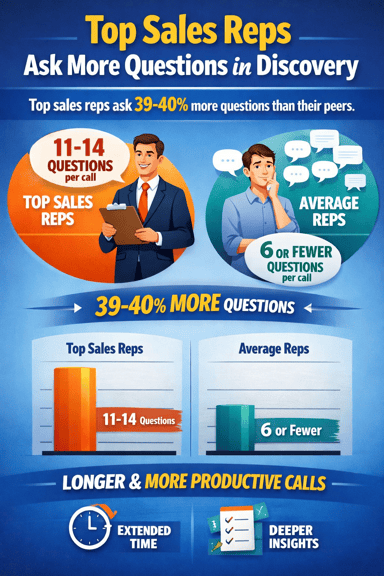
The right questions move a call from polite interest to concrete internal action. According to Gong’s analysis of over one million sales calls, top-performing sales reps ask 39-40 percent more questions during discovery than average performers, and the questions asked focus on business impact, not features.
AI sales tools can amplify that momentum by capturing what’s said, flagging gaps in real time, and transforming conversations into clear next steps. Platforms like Consensus extend that value by adding buyer-intent context before and after the conversation. With Demolytics, reps can see where buyers get stuck, not just what they click. When a buyer rewatches a pricing explanation, skips onboarding, or shares a security section internally, it signals which questions still need resolution and which don’t. Reps walk into the next conversation prepared to address real points of uncertainty, which gives buyers a faster, more relevant path to a decision..
But no AI can replace the human nuance that actually earns trust. Discovery still depends on what only a person can do: ask open-ended, non-leading questions that make buyers pause, think, and articulate what matters most, and what’s at risk if nothing changes.
Where discovery typically breaks down is in the gap between bad and better demo questions. In demos and discovery calls, questions that ask for agreement instead of explanation (like “Does this make sense?” or “Would this be helpful?”) keep conversations moving but rarely move deals forward. Buyers default to polite yeses, not because they’ve uncovered something meaningful, but because the question doesn’t ask them to reflect.
Better questions generate momentum by forcing buyers to describe their real situations: what they’re doing today, where the process slows down, and what they’ve already tried that hasn’t worked. Those answers surface urgency, constraints, and decision criteria that surface-level confirmation questions never reveal.
22 Discovery Questions to Nail Your Sales Pitch
B2B buyers only spend about 17 percent of the buying process talking to you, so make every discovery question count. The questions below blend expert recommendations, call preparation (such as using AI to summarize accounts or highlight gaps), and proven discovery techniques from top sales sources to drive deeper conversations, sharper relevance, and more persuasive pitches.
1. Why did you take my call today?
Purpose: To reveal the buyer’s immediate motivation and timing.
Leading with this discovery question uncovers the real reason you’re talking. The answer tells you if they’re casually exploring, reacting to pressure from leadership, or actively looking for a fix to a pressing problem. Pay attention to whether the motivation sounds urgent or exploratory, then match your tone: more consultative for early exploration, more directive when the pain is already sharp.
2. What would you like to achieve from this meeting?
Purpose: To help align expectations and uncover desired outcomes.
Before you dive in, let the buyer define success for the conversation. Some want a high-level overview, others want technical depth, and some are mainly trying to understand pricing and effort. Once they spell that out, you can shape the agenda around their goal and close the loop at the end by confirming you hit what they came for, which makes it much easier to secure a clear next step.
3. What's stopping you from achieving your goals today?
Purpose: To highlight the most pressing pain point.
Asking what’s in the way pulls the buyer’s specific pain points to the surface. Maybe it’s manual work in spreadsheets, approvals stuck in Slack, duplicate data across tools, or tickets piling up with no clear owner. Use one or two follow-up questions to get specific about frequency, time lost, or revenue impact. The strongest answers expose both urgency and impact, which you can later tie directly to the parts of your solution that address those exact problems.
4. What happens if you do nothing?
Purpose: To surface consequences of inaction and increase urgency.
Shifting the conversation to the consequences of inaction forces the buyer to confront the cost of the status quo. Sometimes the impact is minor, which tells you the problem is a low priority. In other cases, doing nothing may lead to missed revenue targets, falling behind competitors, or mounting operational inefficiency. When buyers spell out those stakes, urgency rises and you gain language you can carry into your pitch and their internal business case.
5. Walk me through your current process for handling this today
Purpose: To reveal workflow gaps and inefficiencies.
Invite the buyer to give you a step-by-step walkthrough of their current workflow. As they describe who’s involved at each step, which tools they use, how information moves, and where delays creep in, you’ll begin to hear the gaps and inefficiencies your solution can address. Those pain points become your demo roadmap and the backbone of your plan.
6. What prompted you start exploring solutions now?
Purpose: To identify the trigger event.
Every evaluation has a trigger. It could be a missed quarter, a new executive with a mandate for change, a painful customer escalation, or pressure from another department. Knowing what sparked the search helps you understand how serious the situation is, how quickly a decision may need to be made, and which angle to emphasize in your pitch, whether that’s risk mitigation, growth, or efficiency.
7. Ho w does this problem impact your team's daily work?
Purpose: To help quantify urgency and pain.
Bring the conversation down to the ground level. Ask them to describe a typical day when this issue shows up. You’ll often hear about tedious manual tasks, duplicate data entry, fire drills, or constant context switching. Try to translate those stories into numbers: hours lost per week, number of people affected, or deals delayed. Later, when you show how your solution works, you can connect directly to those specific daily frustrations.
8. How are you measuring success around this area today?
Purpose: To clarify KPIs and desired outcomes.
Measurement reveals what really matters. Some teams track conversion rates and deal velocity, others care more about adoption, retention, or cost savings. When you know which KPIs are already on their dashboard, you can present benefits in those exact terms. If they aren’t measuring anything yet, that signals an opportunity to help them define meaningful metrics and educate them on how your solution can move those numbers over time.
9. Who else internally cares about solving this problem?
Purpose: To identify hidden influencers and buying committee members.
Use this discovery question to gently open up the buying group. Most meaningful purchases involve more than one voice, and this question draws them out without asking directly who the boss is. Listen for cross functional partners, executive sponsors, or teams that feel the pain even more acutely. Every new name gives you another angle to address and another set of expectations to meet if you want the deal to move forward smoothly.
10. What tools are you currently using, and what's working or not working about them?
Purpose: To gather competitive intel and dissatisfaction.
Shifting the conversation to their current tech stack and environment helps you understand both the baseline and where the frustration lives. They might be on a familiar platform, a patchwork of tools, or a bunch of manual workarounds. What matters most is what they say isn’t working: missing capabilities, clunky workflows, weak reporting, poor support, or too much upkeep. Those specifics become the contrast points you can use when you position your solution.
11. If you could fix this overnight, what would the ideal outcome look like?
Purpose: To reveal desired future state.
Invite a little future casting. The buyer might describe a single source of truth, cleaner workflows, fewer fire drills, or leaders who can answer their own questions without pinging the team. Pay attention to the exact phrases they use, because you can mirror that language later when you position your solution as the bridge from today to that future. At the same time, it gives you a chance to sanity-check expectations and make sure what they want actually matches what you can deliver.
The strongest answers come when buyers anchor their vision in current or past experience. If responses stay vague, follow up by asking what specifically isn’t possible today or what they’ve tried before that fell short.
12. Is this initiative tied to a larger company priority or strategic objective?
Purpose: To help evaluate urgency, budget fit, and relevance.
Zoom out to the company level and find out if the project connects to higher-level goals such as cost reduction, customer experience, or sales funnel optimization. When the initiative lines up with a known company priority, budget and executive support are more likely to be available. If it doesn’t, you may need to help the buyer position your solution in a way that supports objectives leadership already talks about.
13. Based on your website, what are the top challenges your team is navigating right now?
Purpose: To encourage buyers to add depth to what they’re already saying publicly.
Do a quick scan of the company’s public-facing content before the call (site copy, recent announcements, blog posts, hiring pages) and use it as your starting point. Referencing the buyer’s own language signals you’ve done your homework and gives them easy entry into what’s really happening behind the scenes so they can confirm, correct, or add nuance.
Pairing your homework with AI-assisted prep can help you spot likely pain points faster, generate sharper follow-up questions, and draft a pitch that reflects the buyer’s own language before you ever get on the call. And afterward, you can use your call notes to tighten the message with a simple prompt like, “Rewrite my pitch using those identified challenges.”
14. What internal processes or habits are slowing your progress in this area?
Purpose: To surface operational friction.
Internal friction often matters as much as technology. Ask about slow approval paths, misaligned incentives, disconnected systems, or change fatigue. When buyers admit that legal approvals take months or that teams don’t share data, you gain insight into what could derail even a strong solution. You can then explain how your onboarding, training, and support approach is designed to help them overcome those exact barriers.
15. How do you currently prioritize this problem compared to other initiatives?
Purpose: To show urgency relative to competing priorities.
This discovery question helps you see where the project lands compared to everything else competing for attention. If it’s in their top few priorities this quarter, you can expect more focus and a faster path. If it’s getting crowded out by launches, migrations, or other big initiatives, momentum will be slower. Follow up by asking what would need to change for it to move up the list so you know how to position your next step.
16. What have you already tried so far to solve this?
Purpose: To prevent repeating failed approaches.
Past attempts are full of clues. Buyers may have piloted competing tools, hired consultants, built internal dashboards, or set up manual stopgaps. Ask what initially seemed promising and what eventually failed or stalled out. Those details help you sidestep repeat mistakes and give you a way to underscore what’s materially different about your approach compared with things they’ve already tried.
17. What does success look like 6-12 months after this problem?
Purpose: To position long-term value.
Look past the quick win and ask the buyer to get specific about what improves once the problem’s fixed. They might point to outcomes like more predictable revenue, lower turnover, faster onboarding, or the ability to scale without adding headcount. This allows you to align your later messaging and case studies to that horizon so it’s easy for them to picture your solution working over time, not just in the first 30 days.
18. What obstacles could prevent your team from adopting a new solution?
Purpose: To reveal risk factors and internal resistance.
Inviting concerns early brings potential friction points into the open while there’s still time to address them. Common obstacles include limited time for training, skepticism from experienced team members, worries about integration, or fear of disrupting routines that technically still work. Once those concerns are out in the open, you can show how your onboarding process, support model, and product design are built to lower those barriers.
19. How would solving this problem affect other teams or departments?
Purpose: To expand the impact analysis.
This discovery question takes you beyond the primary team your solution is for and explores who else feels the impact. If fixing the problem makes life easier for sales, finance, ops, or customer success too, the business case gets stronger fast and you’re less reliant on a single sales champion. Understanding these ripple effects helps you position your solution as a cross-functional win, which often opens up more budget flexibility and additional champions who will support the project internally.
20. What expectations do your leadership team have around fixing this problem?
Purpose: To match ROI messaging to internal pressure.
Ask this question to pinpoint both explicit targets and unspoken pressure from above. Leaders may be pushing for faster sales cycles, greater accuracy in forecasting, tighter cost control, or better customer sentiment. Once you know those expectations, you can make sure your executive level summary, proof points, and value metrics speak directly to them, giving your champion stronger internal talking points.
21. How are decisions like this typically made on your team?
Purpose: To identify timeline, process, and approval path.
Clarifying the decision process removes guesswork and reduces the chance of late stage surprises. Ask about the usual steps, such as evaluation, pilot, security review, procurement, and final sign off, and who participates at each stage. With that process mapped out, you can suggest a mutual plan that aligns your actions with their internal workflow. Deals move more predictably when both sides are clear on what needs to happen and in what order.
22. What's the most important thing for us to cover today that we haven't touched on?
Purpose: To open the door to critical, hidden insights.
Close discovery by handing control back to the buyer. This question gives them space to surface anything that still feels unresolved, and it often brings out the detail they haven’t said yet, like a hard budget ceiling, a non-negotiable requirement, a looming deadline, an internal skeptic, or a competing tool. Treat whatever comes up as priority information. Address it carefully in the moment, then reflect it in your follow-up so they feel understood and supported.
Use the Right Discovery Questions to Tailor a Winning Sales Pitch
High-performing sales pitches don’t come from clever slides or a long list of features. They come from the clarity you earn during discovery. When you ask more questions (and the right questions), you get an inside look at the buyer’s reality. You learn how the problem hits day to day, what’s at risk if nothing changes, and how decisions get made in their org. From there, the pitch practically writes itself because you’re not guessing anymore. Instead, you’re mapping a personalized path from where they are now to where they want to be.
That matters because buyers (more than ever) are harder to impress and quicker to disengage. Even though 75 percent of B2B buyers prefer a rep-free experience, most (over 80 percent) still connect with sales reps to hear their pitches before buying. And when they do, they expect the pitch to be grounded in their world, not a generic product story. They’re not looking for the “best” product per se; they’re looking for the product that best understands them.
And this is where tools like Consensus can multiply the impact of great discovery. Consensus surfaces buyer interests, priorities, and behavior before you ever join the call (giving you a head start on what matters most). Sellers walk into conversations already equipped with context, and leave with AI-organized insights they can use to tailor the pitch and next steps. It’s discovery-driven selling at scale.
The best sales professionals use discovery questions to create narratives that position their offering as that solution that truly understands the buyer (and therefore becomes the obvious choice). When buyers feel understood rather than sold to, they're more likely to move forward with confidence. It's the difference between pushing a product and solving a problem — one raises resistance, the other removes it.