

We analyzed responses from 400+ presales professionals to deliver the most authoritative benchmarks in the industry on compensation, workload, and how AI is reshaping presales in 2026.
Download or talk to the report today!

Download the 2026 SE Report

Executive Summary
As a presales professional, your expertise directly influences revenue, accelerates sales cycles, and shapes the buyer experience. In 2026, that expertise is more experienced—and more valuable—than ever. Sales Engineers (SE) are bringing deeper tenure to the role and commanding higher compensation as organizations continue to invest in technical presales talent.
Yet, workload pressures persist. Increasing demo volume, expanded buying groups, and ongoing customization demands are shaping how SE time is allocated across teams.
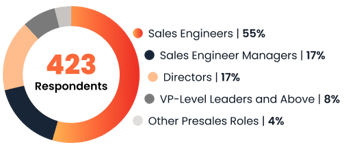
Drawing on insights from 423 presales professionals, this year’s Sales Engineering Compensation & Workload Report provides benchmarks across compensation, experience, demo practices, automation adoption, and burnout. Whether you’re focused on career growth, team performance, or operational efficiency, this report offers a clear view of where presales stand in 2026—and the trends shaping its future.
Key Insights
- Presales talent is becoming more senior—and more expensive
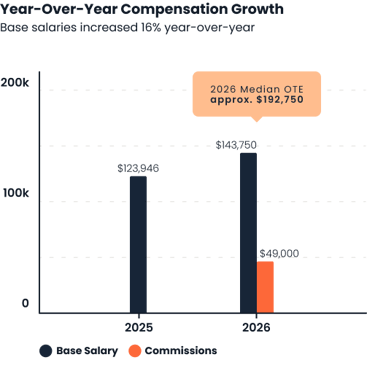
The average SE has ~11 years of presales experience. The 2026 median base salary reached $143,750 (up 16% YoY) with median OTE approaching $192,750. - Burnout and workload pressure continue to rise
The share of SEs reporting no burnout symptoms fell from 20% in 2025 to 11.8% in 2026, while nearly 30% now report persistent burnout or dissatisfaction. Many experienced SEs report working 55–60+ hour weeks to keep up with manual demo demand. - Demo effort remains misaligned with lead qualification
Nearly 37% of demos are delivered to unqualified or under-qualified leads, while 73% of teams report only minimal or informal discovery before the demo, indicating persistent inefficiency in how presales time is allocated. - AI adoption is rising, but productivity gains remain modest
While 88% of SEs report some productivity improvement from AI, most gains remain incremental. Nearly 73% describe improvements as only slight or moderate, indicating that AI has not yet materially reduced the manual preparation burden or long demo cycles reported elsewhere in the study. - Low automation limits the impact of AI on presales workflows
Despite growing interest in AI, 32% of teams report no automation in their demo process and 64% do not use intelligent demo automation. This suggests that AI is often layered onto manual workflows rather than embedded into automated demo delivery models.
Compensation & Tenure
Compensation Is Going Up
Presales teams in 2026 are staffed by experienced professionals with deep tenure and rising compensation. The average SE brings approximately 11 years of total presales experience to the role. That depth of expertise reflects an industry that has matured significantly over the past decade.
As compensation rises, the financial impact of how senior SE time is allocated becomes more significant. Even modest productivity gains from automation or AI-assisted demo workflows could materially impact cost per opportunity. When highly compensated presales professionals spend 6 to 10 hours preparing and delivering demos, particularly for opportunities that may not advance, the labor cost per engagement increases quickly.
Reducing repetitive preparation work or shifting portions of demo delivery to automated or on-demand formats can allow teams to redirect senior expertise toward higher-value activities such as discovery, technical validation, and complex stakeholder engagement.
The Senior SE Trap
Presales organizations are facing a structural challenge:
Sales Engineers are becoming more senior, but much of their work has not evolved with them.
The average SE now has ~11 years of experience and earns nearly $193K OTE. Yet 37% of demos still go to unqualified leads, discovery is minimal or informal nearly 73% of the time, and demo preparation can take 6–10+ hours.
This creates a costly mismatch: organizations are paying expert rates for work that often doesn’t require expert judgment.
The result is rising workload pressure, increasing burnout, and growing interest in automation that can shift repetitive tasks away from senior presales talent.
Revenue Accountability Defines the Modern Presales Role
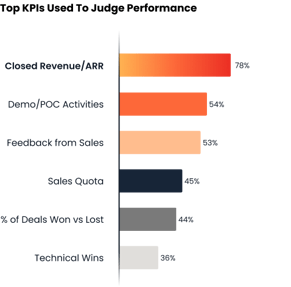
Rising compensation is also accompanied by increasingly commercial performance expectations. In 2026, the top KPIs used to evaluate presales performance are heavily tied to revenue contribution and sales execution rather than purely technical outcomes.
The most commonly used metrics are closed revenue/ARR (78%), demo or POC activity (54%), and feedback from sales (53%). Technical wins remain part of the mix, but trail these revenue- and activity-oriented measures.
These findings suggest that presales is being evaluated less as a support function and more as a revenue-influencing role with measurable commercial impact. That shift helps explain both rising compensation and the growing pressure on SEs to perform across demo delivery, deal progression, and sales partnership.
Team-Based Quotas Still Dominate
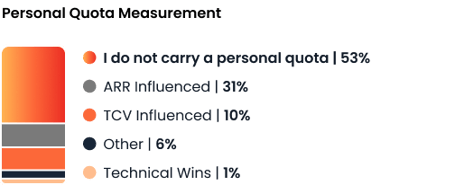
Despite stronger commercial expectations, quota structures remain more team-oriented than individually assigned. Nearly 58% of respondents say their team carries a quota, while 35% report carrying no personal quota, and only 23% say they carry an individual quota.
.png?width=287&height=285&name=respondents%20(1).png)
Where quotas are used, ARR-influenced remains the dominant measurement approach for both team and personal performance. This suggests that organizations increasingly expect presales to influence revenue outcomes, but often assess that contribution collectively rather than through fully individualized selling targets. In practice, that structure reinforces the idea that presales success is closely tied to team execution across discovery, demos, and deal support.
.png?width=460&height=188&name=sec%20(1).png)
Sales Cycles Have Shortened Slightly, but Complexity Remains
Median deal size remains consistent with 2025 at $100,000, while the average sales cycle has shortened modestly from 9 months to 7.9 months. At the same time, the market remains split. Nearly 49% of respondents report typical sales cycles of 1 to 6 months, while 40% report cycles of 7 to 12 months and 11% report cycles of 13 months or longer.
This distribution suggests that while some organizations may be benefiting from faster deal motion, a large share of presales teams still operate in extended, multi-stage buying environments that require sustained technical support over time.
As a result, compression in average cycle length does not necessarily reduce the complexity or workload associated with supporting modern deals.
.png?width=373&height=364&name=column%20(1).png)
High Experience Levels Mask Retention Risk
Despite an average of 10+ years of experience for most SEs, role tenure remains relatively short. 72% of respondents have been in their current role for five years or fewer, and 30% report a tenure of just one to two years.
Onboarding experienced SEs does lead to a relatively quick ramp time—around 1.2 months to full productivity, but it may also reflect a hiring model that prioritizes immediate contribution over developing earlier-career talent internally. Over time, that dynamic can narrow the entry-level pipeline and make organizations more dependent on a relatively small pool of experienced, higher-cost professionals.
Retention risk is amplified by the fact that career progression appears to matter alongside compensation: while 31% cite higher compensation as the primary reason for changing roles, another 26% point to advancement-related moves, including senior IC growth (11%) and leadership opportunities (15%).
Taken together, these dynamics place greater emphasis on retention, career pathing, knowledge transfer, and effective allocation of senior expertise. In a top-heavy talent market, organizations may need to do more than hire experienced SEs quickly, they may also need to create clearer growth paths and reduce low-value work if they want to keep them.
A Concentrated Talent Pool Raises the Stakes
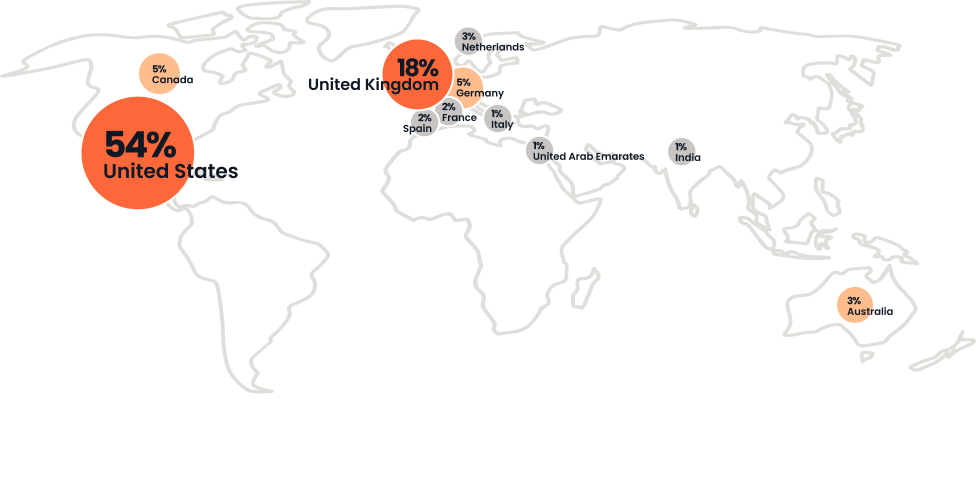
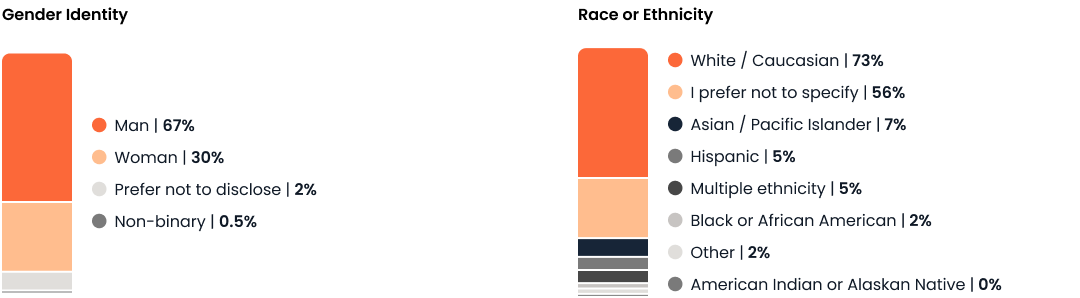
Presales talent is concentrated across geography and demographics. The majority of respondents are based in the US (54%) and in the UK (18%). And the workforce remains predominantly male (67%) and White/Caucasian (73%).
With a specialized and concentrated talent pool earning premium compensation, retention and effective workload design become increasingly important operational considerations.
Workload, Burnout, and Capacity Risk
Time Allocation Extends Beyond Core Presales Work
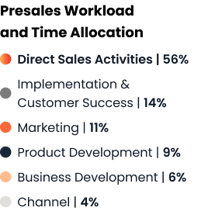
Presales remains a high-impact function, but workload pressure is shaped not only by demo demand but also by how broadly the role is defined within many organizations. Survey responses indicate that SEs spend only 56% of their time on direct sales activities, such as active sales cycles, demos, discovery, and Proof of Concepts (POCs).
The remaining 44% is allocated to cross-functional work, including implementation or customer success support (14%), marketing activities (11%), and product development collaboration (9%).
While these contributions may add value across the business, they also reduce the time available for core presales responsibilities such as discovery, technical validation, and buyer-facing engagement. As a result, many SEs are operating as cross-functional technical resources while still being measured against full presales expectations.
Team Structure Influences Workload Pressure
Presales team structures vary widely, but most organizations still operate around a standard 3:1–5:1 AE-to-SE ratio, used by roughly 40% of respondents.
Beyond this common model, coverage structures diverge significantly depending on sales motion and deal complexity.
Enterprise organizations tend to favor concierge-style coverage, where SEs work closely with a small number of account executives. These lower ratios reflect the deeper technical engagement and customization often required in complex enterprise deals.
Mid-market teams most commonly operate within the standard coverage model, balancing moderate demo volume with the need for some solution tailoring. In contrast, SMB environments frequently rely on higher-ratio structures or shared presales resources. In these organizations, SEs may support many account executives at once or operate as pooled technical specialists serving multiple opportunities across the sales team.
.png?width=421&height=172&name=sec%20(2).png)
These structural differences create distinct types of workload pressure. Enterprise SEs often face longer deal cycles and heavy customization demands, while SMB SEs are more likely to experience pressure from high demo volume and broad sales coverage expectations. In both cases, team structure plays a central role in determining how presales capacity is allocated.
.png?width=407&height=418&name=column%20(3).png)
Burnout Continues to Rise
Burnout levels have increased year-over-year. In 2025, 20% of SEs reported no symptoms of burnout. In 2026, that figure fell to 12%. At the same time, the share reporting persistent to significant burnout rose from 17% to over one-third (37%).
Among professionals with 10+ years in presales, many report working 55–60+ hour weeks, indicating that workload strain is particularly concentrated among experienced talent. As organizations rely more heavily on senior SEs to support complex, high-value opportunities, protecting that expertise becomes increasingly important.
.png?width=286&height=264&name=column%20(4).png)
Presales Teams Are Asking for Capacity Relief
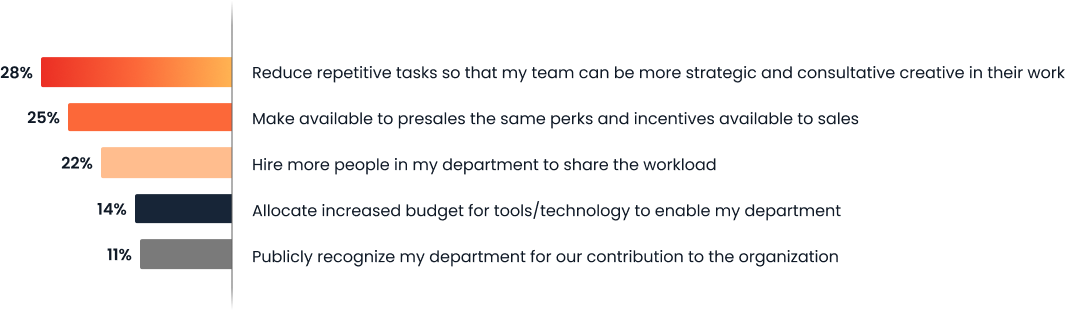
When asked what would most improve work life, respondents pointed first to changes that would reduce repetitive workload and improve capacity. The leading response was reducing repetitive tasks so SEs can focus on higher-value work, indicating strong demand for operational changes that free presales teams from manual execution.
The second and third responses reinforce the same theme. 25% say presales should receive the same perks and incentives as sales, while 22% say hiring more people to share the workload would have the greatest impact, up from 14% in 2025. Together, these responses suggest that many presales teams feel stretched across increasing demands while lacking the structural support or resources available to revenue-facing roles.
Shifting SE Time Toward Higher-Value Work
A related finding reinforces this desire to rebalance presales workloads. When asked which activities most improve outcomes, 34% of respondents ranked discovery as the most impactful, indicating strong interest in shifting time away from repetitive execution toward earlier-stage, strategic engagement.
One approach gaining traction is demo automation and on-demand product experiences, which allow teams to shift repeatable product walkthroughs from live meetings to reusable digital assets. Rather than rebuilding introductory demos for each opportunity, presales teams can provide guided product experiences that buyers explore asynchronously before or between live calls.
Organizations adopting these models report meaningful operational improvements. For example, Hexagon used automated demos to eliminate a two-week demo lag time and reclaim roughly 4,000 hours of presales effort, allowing Solution Consultants to focus more heavily on enterprise opportunities and deeper technical conversations. Similarly, Bazaarvoice reduced repetitive demos by up to 25% and shortened some SMB sales cycles by as much as 33%, while uncovering over 150 additional stakeholders through automated demo sharing and analytics.
These examples suggest that improving presales work life may depend less on adding headcount and more on redesigning workflows so that repeatable demo delivery happens asynchronously, allowing SEs to focus their time on discovery, technical validation, and complex deal support.
The Financial Impact of Qualification & Discovery Gaps
Demo Qualification Trends
As presales compensation rises, the efficiency of qualification and discovery has greater financial implications. When demos are delivered before prospects are fully vetted, senior SE time is allocated to lower-probability opportunities, increasing both direct labor cost and opportunity cost.
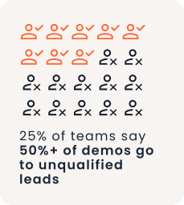
Nearly 37% of demos are delivered to unqualified or under-qualified leads—virtually unchanged from 35% in 2025.
The problem runs deeper than the average suggests. Nearly a quarter of teams report that more than half of their demos go to unqualified prospects, indicating that inefficiency is concentrated within certain organizations.
Several operational factors appear to contribute to this misalignment between presales effort and opportunity quality. Survey responses and buyer engagement data suggest that inefficiencies often arise from:
- Limited discovery prior to demos, which can lead teams to begin customization before qualification is fully established.
- Highly manual demo construction, requiring teams to rebuild portions of the product story for each opportunity.
- Underutilization of automation and AI, which leaves repetitive demo delivery and preparation work largely manual.
- Scheduling delays that slow product access, requiring prospects to wait several business days before seeing the product.
- Misalignment between demo production and buyer engagement behavior, where buyers often watch only a portion of longer demos.
- Discovery friction in early interactions, where buyers frequently disengage after answering only one or two qualification questions.
Taken together, these patterns suggest that inefficiency in presales workflows rarely stems from a single issue. Instead, it often emerges from a combination of limited qualification, manual demo preparation, and misalignment between how demos are produced and how buyers actually engage with them.
The sections that follow examine how these operational dynamics translate into both financial cost and workflow complexity for presales teams.
The Cost Per Demo
A traditional manual demo costs an estimated $288–$330 per session, based on prep time and blended SE/AE compensation.
Time investment remains significant:
- 28% spend six or more staff hours preparing and following up on a single demo
- 13% spend 6 to 10 hours
- 15% spend 11+ hours
When more than a third of demo volume is directed toward unqualified opportunities, the financial impact scales accordingly, particularly as presales compensation increases.
Discovery Practices Remain Limited
Nearly 73% of teams report conducting only “minimal” or “informal” discovery prior to a demo. In many cases, deeper qualification shifts into the demo itself, increasing preparation and customization demands within presales.
At the same time, 34% of respondents ranked discovery as the activity most likely to improve outcomes, indicating broad internal recognition of its importance.
Findings from Consensus’ B2B Buyer Behavior Report provide additional context on buyer participation in discovery flows:
- 75%+ of viewers answer only one discovery question
- 90% answer two or fewer
- Demos ask 1.91 questions on average, but viewers answer only 1.37
These patterns suggest discovery participation declines quickly as friction increases, reinforcing the importance of keeping qualification lightweight and focused.
.png?width=374&height=165&name=sec%20(3).png)
Demo Process Automation & Stakeholder Complexity
Demo Production vs. Consumption
As buyer behavior evolves and buying groups expand, demo production and delivery models are under increasing pressure. Teams are investing heavily in demos that buyers only partially consume:
- The average demo length is 15.23 minutes
- The average view time is 5.23 minutes
- Buyer view time dropped 5.5% year-over-year
This gap indicates that buyers are engaging selectively with demo content.
Manual Demo Work Remains Widespread
Demo construction remains largely manual. Most organizations report that at least half of demo work requires custom effort.
- 28% say their demos are only 0–25% standardized
- 38% say they are 30–50% standardized
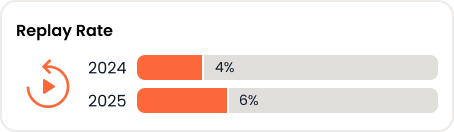
Replay data reinforces this pattern. Over the past two years, replay rates increased 41%, from 4% in Q1 2024 to 6% in Q4 2025, suggesting buyers are revisiting specific segments rather than consuming demos linearly.
Scheduling Delays Slow Multi-Stakeholder Engagement
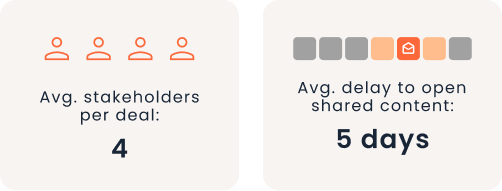
The average deal involves four unique stakeholders, underscoring the growing importance of multi-person engagement in the buying process.
Buyer response time adds additional delay. On average, buyers open shared content five days after it is sent, and nearly 80% wait 3–10 business days to see the product.
However, findings from Consensus’ B2B Buyer Behavior Report show that nearly 45% of demo views occur within the first 60 minutes after content is sent, indicating a meaningful early engagement window when timing and access align.
.png?width=502&height=163&name=Frame%204731%20(1).png)
When engagement depends primarily on scheduled live meetings, expanding access across stakeholders can introduce additional delay.
Broader Stakeholder Engagement Correlates with Higher Deal Attachment
Engagement patterns differ meaningfully between primary recipients and additional stakeholders.
Stakeholders who are discovered and looped into shared demos engage at a 61% rate, compared to 28% for the primary recipient, and view demos an average of 88 hours sooner.
The deal association data reflects this:
- Demoboards with 0 stakeholders: 19% tied to deals
- Demoboards with 7+ stakeholders: 36% tied to deals
Demoboards shared across broader stakeholder groups are associated with higher rates of deal attachment.
.png?width=504&height=195&name=column%20(5).png)
Automation Adoption Remains Limited
Despite growing demo volume and stakeholder complexity:
- 32% of teams report no automation in their demo process
- 64% do not use intelligent demo automation
Where manual delivery remains the primary model, increased opportunity volume can require additional preparation and coordination time—particularly within presales teams.
AI Adoption
Limited Automation Constrains Productivity Gains
While interest in AI is rising, operational automation remains limited. Nearly 64% of teams do not use intelligent demo automation, and 32% automate no part of the demo process. With a median OTE approaching $192,750, the productivity gap represents significant untapped leverage.
Workforce sentiment toward AI is broadly positive: 88% report some level of productivity increase. However, the magnitude of those gains varies considerably. Most improvements remain incremental rather than transformational.
.png?width=504&height=190&name=sec%20(4).png)
Nearly 73% of respondents report only slight or moderate gains, while just 15% describe productivity improvements as significant or transformational. This suggests that AI is improving efficiency incrementally but has not yet reduced the 6–10+ hour manual demo preparation cycles highlighted elsewhere in the study.

In many cases, AI appears to be layered onto existing manual workflows rather than transforming the demo delivery model itself. Meaningful productivity gains may depend less on AI adoption alone and more on embedding intelligence into standardized, automated demo processes that reduce repetitive preparation and live delivery volume.
Survey data on presales technology stacks provides additional context. When asked which tools deliver the most value, respondents ranked video (61%) and product tours (45%) among the most impactful capabilities.
These formats represent two of the most time-intensive areas of demo production, suggesting that applying AI directly to demo creation and interactive product experiences may offer the greatest opportunity for productivity improvement.
Where AI Can Create the Greatest Lift for SEs
AI has the potential to deliver more meaningful gains when it is applied directly to the most time-consuming presales tasks: demo creation, customization, and delivery.
In demo creation, AI can reduce the effort required to transform raw product recordings into polished demo assets. Capabilities such as:
- Automated editing
- AI-generated voice narration
- Rapid content formatting
allow teams to produce reusable video demos more quickly, reducing the manual effort traditionally required to build demo libraries.
AI can also support interactive product tours and simulations, helping teams generate structured walkthroughs that guide buyers through key workflows without requiring a live session. By automating portions of demo creation and standardizing repeatable product experiences, presales teams can reduce the time spent rebuilding similar demos for each opportunity.
Finally, AI-powered analytics and recommendation engines can help teams deliver the right demo content to the right stakeholders. Instead of relying entirely on scheduled meetings, presales teams can use engagement signals to identify buyer interests, discover additional stakeholders, and tailor follow-up conversations more effectively.
When AI is embedded into demo workflows in these ways, it can shift presales work away from repetitive preparation and toward higher-value activities such as discovery, technical validation, and solution design.
Confidence in the Strategic Value of the SE Role
While AI adoption continues to expand, concern about job displacement remains low across presales teams.
Nearly half of respondents (47%) report being “not concerned at all” about AI replacing SEs, and more than 80% express little to no concern overall.
The confidence reflects the strategic, consultative, and relationship-driven nature of the role—areas where human expertise, contextual judgment, and buyer alignment remain critical despite advances in automation.
Since a single manual demo costs up to $330 in labor, every automated view represents a direct preservation of budget.
.png?width=556&height=215&name=column%20(6).png)
Artificial intelligence is beginning to change this equation.
While 88% of respondents say AI is improving their productivity, most describe the gains as incremental rather than transformational. In many organizations, AI tools are layered onto existing manual workflows rather than fundamentally changing how demos are delivered or scaled.
Artificial intelligence is also emerging as a key lever for expanding presales capacity:
- 57% explicitly say AI is improving their workload.
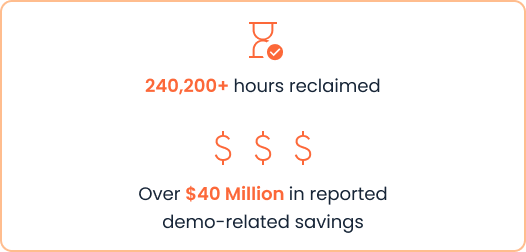
- Top enterprise accounts using AI-driven automation are reclaiming an average of 240,200 hours of team time, translating to more than $40M in total cost-per-demo savings.
These results suggest that the real opportunity is not simply adopting AI tools, but redesigning presales workflows so senior expertise is focused on the strategic work only humans can perform.
Operational Strategies to Improve Talent Utilization
Strengthen Discovery and Qualification
The data suggests improving talent utilization depends less on headcount and more on operating model design, particularly how discovery, demo production, and stakeholder engagement are structured.
Nearly 37% of demo effort is directed toward unqualified or under-qualified opportunities, while 73% of teams report minimal or informal discovery.
Introducing a consistent, lightweight discovery standard—such as one to two targeted qualification questions—may help better align demo effort with higher-probability opportunities.
Insights from Consensus’ B2B Buyer Behavior Report indicate that most buyers will answer only one discovery question, with participation declining sharply after two. On average, viewers respond to 1.37 questions, even when nearly two are asked.
Taken together, these data points support a streamlined approach that captures essential qualification inputs without increasing buyer friction.
Align Demo Structure with Buyer Consumption Patterns
Average demo length (15.23 minutes) exceeds average buyer view time (5.23 minutes). This gap suggests opportunities to structure demos in shorter, modular segments aligned to engagement behavior.
Organizations reporting higher levels of demo standardization may reduce customization time while preserving personalization through structured paths or chapters.
Expand Stakeholder Engagement Earlier
Deals involving broader stakeholder engagement show higher rates of deal association (36.2% with 7+ stakeholders vs. 18.9% with none).
Similarly, discovered stakeholders engage at a 61% rate and view demos 88 hours sooner than primary recipients. Earlier distribution of demo access may support more comprehensive buying committee engagement before live scheduling becomes a constraint.
Expand Capacity Through Automation and AI
Workforce sentiment toward automation remains favorable:
- 88% report AI increases productivity
- 57% say it improves workload
- 82% express little to no concern that AI will replace them
Enterprise benchmarks also indicate that automated demo delivery can reduce repetitive live-demo volume. Some organizations report reclaiming more than 240,000 hours of presales time, with significant associated cost savings (upwards of $40 million).
The Evolving Role of Presales
Organizations are investing in experienced presales professionals at historically high compensation levels, reflecting the strategic importance of the role.
The 2026 data suggests that sustaining performance will depend increasingly on how effectively senior expertise is deployed—particularly across qualification, demo production, and stakeholder engagement.
When operating models align with buyer behavior and workload realities, presales teams can maintain impact while managing capacity more sustainably.